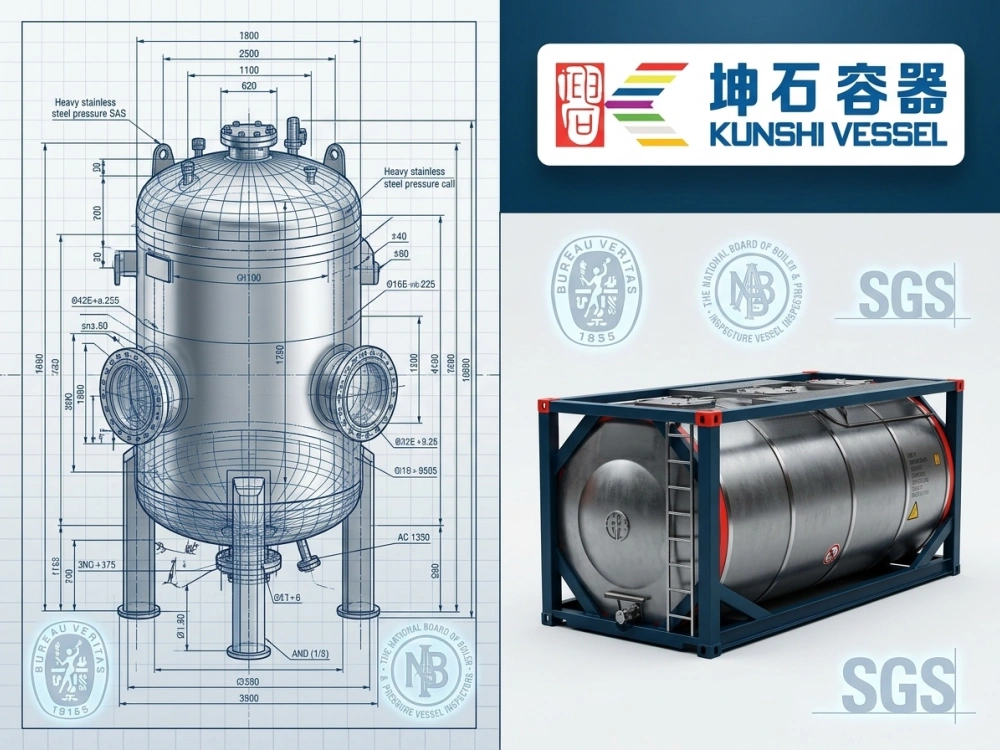
Navigating international pressure equipment regulations is the single most critical factor for global EPC contractors, gas distributors, and chemical logistics operators. Understanding the technical divergence between ASME Section VIII and EU TPED (Transportable Pressure Equipment Directive) ensures frictionless cross-border customs clearance and zero-defect operational safety.
Key Takeaways for Compliance Officers & Procurement Heads
- ASME Section VIII Div 1/2 (U-Stamp): Primary design and fabrication standard for stationary pressure vessels across North America and global energy projects.
- EU TPED 2010/35/EU (Pi Mark π): Mandatory European directive governing transportable pressure equipment, intermodal ISO tanks, and gas cylinders (ADR/RID compliant)[cite: 1, 2, 11].
- Dual-Certification Advantage: Co-designing vessels to meet both ASME and TPED specifications maximizes asset versatility and global resale value.
- Third-Party Inspection Mandate: Requires independent Authorized Inspectors (AI) or Notified Bodies (e.g., Bureau Veritas, National Board) for design approval and hydrostatic testing[cite: 1, 2, 11].
Overview of ASME Section VIII (American Standard)
Published by the American Society of Mechanical Engineers, ASME Section VIII is recognized in over 100 countries for stationary pressure vessel safety.
- Division 1: Covers design based on rules, applicable to working pressures from 15 psi (0.1 MPa) up to 3,000 psi (20 MPa)[cite: 1, 2].
- Division 2: Design-by-analysis rules allowing higher design allowable stress values, optimal for thick-walled high-pressure containment and weight optimization[cite: 1].
- Quality Authorization: Stamping with the ASME “U” or “U2” symbol signifies rigorous material traceability (MTR 3.1/3.2) and Authorized Inspector sign-offs[cite: 1, 2].
Overview of EU TPED (Transportable Equipment Directive)
Unlike stationary ASME vessels, transportable pressure equipment intended for highway, rail, or sea transit within the European Economic Area must comply with the Transportable Pressure Equipment Directive (2010/35/EU / TPED)[cite: 1, 11].
- The Pi Mark (π): Stamped on vessels, gas cylinders, and ISO tanks to prove conformity with international dangerous goods transport regulations (ADR, RID, AND)[cite: 1, 11].
- Scope: Encompasses UN portable tanks (T1–T75 codes), cryogenic dewars, and high-pressure gas cylinders[cite: 1, 2].
- Notified Body Involvement: Requires strict type approval, in-process manufacturing oversight, and initial inspection by a accredited European Notified Body (such as Bureau Veritas).
ASME Sec VIII vs. EU TPED Technical Comparison
| Compliance Feature | ASME Section VIII (Div 1/2) | EU TPED Directive (2010/35/EU) |
|---|---|---|
| Primary Focus | Stationary Vessels & Plant Infrastructure[cite: 1] | Transportable Equipment & ISO Tanks[cite: 1, 2] |
| Certification Mark | ASME “U” / “U2” Stamp & NB Registration[cite: 1, 11] | Pi Mark (π) + Notified Body ID[cite: 11] |
| Design Methodology | Design by Rules (Div 1) / FEA Analysis (Div 2) | EN 14025, EN 13530, or ADR/RID Regulations[cite: 2] |
| Third-Party Oversight | ASME Authorized Inspector (AI)[cite: 1] | EU Notified Body (e.g., Bureau Veritas)[cite: 11] |
Quality Control & Audit Documentation Requirements
Whether building to ASME or TPED standards, global buyers must mandate the following quality assurance records:
- Material Test Reports (MTR EN 10204 3.1/3.2): Full heat-number chemical and mechanical traceability for shell plates and forgings[cite: 1, 2].
- Welding Procedure Specifications (WPS/PQR): Qualified weld procedures according to ASME Sec IX or ISO 15614.
- 100% NDT Weld Examinations: Radiographic (RT), Ultrasonic (UT), and Magnetic Particle (MT) test reports signed by ASNT/EN level II/III inspectors[cite: 2].
Global Regulatory Engineering by Keystone Vessel
Keystone Vessel holds full ASME U-Stamp, National Board (NB), EU TPED, US DOT, and DNV certifications. We engineer fully dual-certified pressure vessels and ISO tanks for seamless global transit[cite: 1, 2, 11].
Request Compliance Dossier Direct WhatsApp Regulatory Engineering Contact (+86 186 7228 4442)
Frequently Asked Questions (FAQ)
Q1: Can a vessel be dual-certified for both ASME and EU TPED?
Yes. Keystone Vessel frequently builds dual-stamped pressure containers that satisfy both ASME Section VIII structural criteria and EU TPED (ADR/RID) transport directives, enabling worldwide deployment[cite: 1, 2, 11].
Q2: What is the significance of Bureau Veritas (BV) certification for TPED?
Bureau Veritas acts as an authorized EU Notified Body. BV type-approval and certificate issuance guarantee that ISO tanks and portable vessels legally comply with European hazardous goods transport laws[cite: 1, 11].