
Key Takeaways for Procurement & Logistics Directors
- UN T1–T10 Codes: Engineered for non-hazardous and low-hazard liquid chemicals with lower working pressures (1.5 bar to 4.0 bar).
- UN T11–T22 Codes: Heavy-duty liquid tanks for corrosive, toxic, and flammable dangerous goods (bottom or top discharge options)[cite: 2].
- UN T50 Code: Dedicated high-pressure portable tanks for liquefied gases such as LPG, Ammonia, and Fluorocarbons.
- UN T75 Code: Vacuum-insulated cryogenic tanks for ultra-cold industrial gases (LIN, LOX, LAR, LNG) down to -196°C.
- Global Certifications: Full regulatory compliance with IMDG, ADR/RID, ASME Section VIII, US DOT, and EU TPED is mandatory for international ocean and rail transit[cite: 1, 2].
Understanding UN Portable Tank Classifications (T1 to T75)
The United Nations (UN) Portable Tank regulations classify intermodal tank containers based on working pressure, shell thickness, bottom openings, and pressure-relief requirements. Selecting the wrong UN T-code can lead to severe regulatory fines, port delays, or catastrophic chemical leakage during intermodal transport.
1. Liquid Chemical ISO Tanks (UN T1 – UN T22)
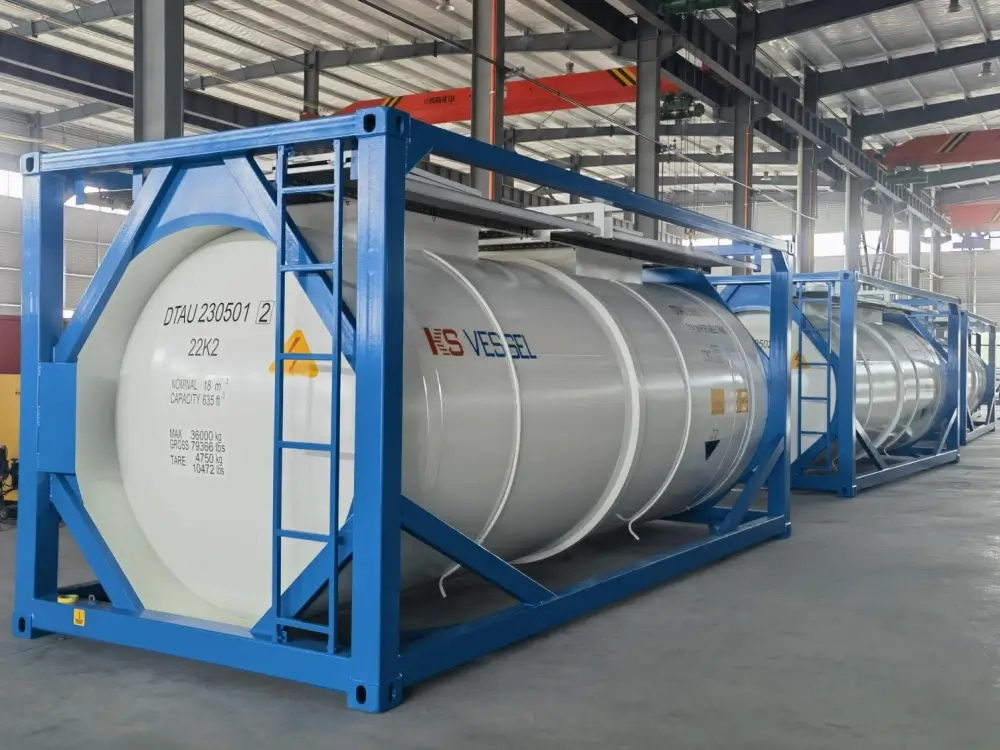
Liquid ISO tank containers are the backbone of global bulk liquid logistics. They are housed inside a standard 20ft ISO structural steel frame for seamless ocean vessel, rail, and truck transport.
- UN T1 – UN T10: Suitable for general liquids, food-grade cargoes, and low-hazard chemicals. Working pressures range from 1.5 bar to 4.0 bar.
- UN T11 (Most Common): Designed for hazardous liquid chemicals (Class 3, 6.1, 8). Features a 4.0 bar test pressure and bottom discharge options[cite: 2].
- UN T14 & UN T20: Heavy-gauge 316L stainless steel or lined shells (PTFE/Rubber) for highly aggressive acids, toxic substances, and high-purity chemicals requiring top discharge only[cite: 1, 2].
2. Liquefied Gas Portable Tanks (UN T50)
UN T50 portable tanks are engineered specifically for non-refrigerated liquefied gases under extreme vapor pressure. Manufactured from heavy-gauge carbon steel or alloy steel, T50 tanks feature design pressures up to 30+ bar to accommodate substances such as Liquefied Petroleum Gas (LPG), Anhydrous Ammonia, and Refrigerant Gases[cite: 1, 2].
3. Cryogenic Liquid ISO Tanks (UN T75)
UN T75 containers are double-walled, vacuum-insulated pressure vessels designed for cryogenic liquid gases. Utilizing multi-layer insulation and stainless steel inner vessels, T75 tanks maintain stable ultra-low temperatures (-196°C) for long-distance transport of Liquid Nitrogen (LIN), Liquid Oxygen (LOX), Liquid Argon (LAR), and Liquefied Natural Gas (LNG)[cite: 1, 2].
UN T-Code Technical Specification Matrix
Use the matrix below to cross-reference cargo requirements with container engineering specifications:
| UN T-Code | Primary Cargo Type | Min. Test Pressure | Discharge Type | Typical Shell Material |
|---|---|---|---|---|
| T1 – T10 | Non-hazardous / Mild Chemicals | 1.5 – 4.0 Bar | Bottom or Top | 304 / 316L Stainless Steel[cite: 2] |
| T11 – T14 | Hazardous Liquids / Corrosives / Solvents | 4.0 – 6.0 Bar | Bottom (T11) or Top (T14) | 316L SS / Fluoropolymer Lined[cite: 2] |
| T50 | Liquefied Compressed Gases (LPG, Ammonia) | Up to 30+ Bar | Bottom / Protected Cabinet | Heavy-Gauge Carbon / Alloy Steel[cite: 2] |
| T75 | Cryogenic Liquids (LIN, LOX, LAR, LNG) | 7.0 – 22.0 Bar (Cryogenic) | Top or Cabinet Piping | Vacuum Double-Wall 316L SS[cite: 1, 2] |
Key Engineering Factors in ISO Tank Selection
1. Shell Metallurgy & Anti-Corrosion Linings
Chemical compatibility dictates vessel metallurgy. While 316L stainless steel provides excellent protection against flammables and general organic acids, highly corrosive substances (such as Hydrochloric Acid or Hydrofluoric Acid) demand specialized internal coatings or linings, such as rubber, PTFE, or PE[cite: 2].
2. Quality Control & Weld Inspection (100% NDT)
Intermodal ISO tanks endure dynamic fatigue and vibration during ocean transit. Premium tank manufacturing requires 100% Non-Destructive Testing (NDT)—including Radiographic (RT), Ultrasonic (UT), and high-sensitivity Helium Mass Spectrometer leak audits—to ensure zero structural defects[cite: 2].
3. Regulatory Certifications & Maritime Approvals
International cross-border logistics requires mandatory third-party certifications. Ensure your ISO tank supplier provides comprehensive documentation signed off by leading classification societies[cite: 1, 2]:
- ASME Section VIII Div 1/2: Pressure vessel structural integrity stamp[cite: 1].
- US DOT & EU TPED: Mandatory approval for US and European highway/rail transit[cite: 1].
- DNV 2.7-1 / EN 12079: Mandatory for offshore marine platform crane lifting operations.
- Maritime Class Certs (BV, CCS, ABS): Compliance with IMDG Code intermodal ocean freight.
Partner with Keystone Vessel Manufacturing Co., Ltd.
As a global market leader in UN T1–T75 ISO tank containers and high-pressure vessels, Keystone Vessel delivers ASME, US DOT, and TPED certified containment systems built with 100% NDT quality assurance[cite: 1, 2].
Request ISO Tank Quotation Direct WhatsApp Logistics Support (+86 186 7228 4442)
Frequently Asked Questions (FAQ)
Q1: What is the lifespan of an ISO tank container?
With proper periodic inspection (mandatory 2.5-year pressure test and 5-year hydrostatic re-test), a high-quality 316L stainless steel ISO tank container has a operational service lifespan exceeding 20 years.
Q2: What is the difference between a UN T11 and UN T14 ISO tank?
A UN T11 tank is equipped with bottom discharge valves for general hazardous liquids[cite: 2]. A UN T14 tank is designed for highly toxic or aggressive chemicals and strictly requires top discharge only to eliminate risk of bottom leakage[cite: 2].
Q3: Can Keystone Vessel manufacture custom UN portable tanks?
Yes. Keystone Vessel provides full OEM/ODM engineering customization across UN T1 through T75 codes, offering options for steam heating coils, electrical trace heating, baffles, specialized anti-corrosion linings, and DNV 2.7-1 offshore frames[cite: 1, 2].